
U.S. begins blockade in Strait of Hormuz; Trump warns Iran ‘attack ships’ to stay away

The US president said if any of Iran’s “fast attack ships” come near the blockade, they will be taken out.
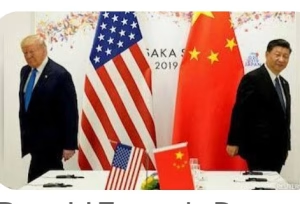
The US military blockade on Iranian ports started at 10 a.m. ET today, after weekend peace talks in Pakistan faltered. President Donald Trump said the US will sink any Iranian “fast attack ships” that come near the blockade.
Mr Trump said the US will use the “same system of kill” that it employs against drug boats in the Caribbean and Pacific Ocean. Neutral vessels currently in Iranian ports were set to be given a “grace period” to leave.
The blockade comes after US-Iran talks in Islamabad failed to reopen the Strait of Hormuz or end the war. Diplomats were scrambling to keep the negotiation route open. Pakistan’s Prime Minister Shehbaz Sharif said “full efforts” were still being made to resolve the conflict.
The first round of talks faltered over Iran’s nuclear activities and control of the Strait of Hormuz. US Central Command said the new blockade is aimed at “vessels of all nations entering or departing Iranian ports and coastal areas”.
“Centcom forces will not impede freedom of navigation for vessels transiting the Strait of Hormuz to and from non-Iranian ports,” it added.
An Iranian military spokesman said US restrictions on vessels in international waters were illegal and “amount to piracy”. Iran will implement a “permanent mechanism” to control the strait, he said.
The spokesman added that Gulf ports must be accessible to all vessels and that no port in the Gulf, or Gulf of Oman, would remain secure if Iranian ports were endangered.
The UKMTO said it was informed of “maritime access restrictions” to be outlined in a notice to seafarers. The agency said its understanding was that the measures would apply to all vessels, regardless of flag, engaging with Iranian ports, oil terminals, and coastal facilities across the Arabian Gulf, Gulf of Oman, and the Arabian Sea east of the Strait of Hormuz.
It said the restrictions cover Iran’s entire coastline, including ports and energy infrastructure. Vessels “may encounter military presence, communications checks, or right-of-visit procedures”, it warned.
Neutral vessels currently in Iranian ports have been granted a limited grace period to depart, it said, to be specified in the notice to mariners.
Mr Trump said on Sunday that the US Navy would start blockading the strategic waterway, raising the stakes after talks with Iran failed to secure a deal to end the war, jeopardising a fragile two-week ceasefire. The weekend negotiations in Pakistan’s capital Islamabad were the first direct US-Iranian meeting in more than a decade and the highest-level discussions since the 1979 Islamic revolution.
In a post on social media, Mr Trump said the US would take action against every vessel in international waters that had paid a toll to Iran. He also said America would begin destroying Iranian mines in the strait, a choke point for about 20 per cent of global energy supplies that Iran has blocked since the start of the conflict in February.
“No one who pays an illegal toll will have safe passage on the high seas,” Mr Trump wrote. He added that “any Iranian who fires at us, or at peaceful vessels, will be blown to hell”.
Iran’s Islamic Revolutionary Guard Corps responded by warning that military vessels approaching the strait would be considered a breach of the ceasefire and would be dealt with harshly, emphasising the risk of further escalation.
Iran’s Parliament Speaker Mohammad Bagher Ghalibaf, who led his country’s delegation at the Islamabad talks along with Foreign Minister Abbas Araghchi, said Mr Trump’s latest threats would have no effect on Iran. “If you fight, we will fight, and if you come forward with logic, we will deal with logic,” he said in comments reported by state media.
China on Monday called for calm and restraint on all sides. Foreign Ministry spokesman Guo Jiakun said keeping the waterway safe, stable and unimpeded served the common interests of the international community. China is ready to work with all sides to protect energy security and supplies, he added.
Blocking Iranian shipments would cut off a significant source of oil from the world’s markets. Iran exported 1.84 million barrels per day of crude in March and has shipped 1.71 million bpd so far in April, compared with a full-year average of 1.68 million bpd in 2025, data from analytics company Kpler showed.
However, a surge in Iranian output before the war started on February 28 has led to near-record levels of Iranian oil loaded on ships – more than 180 million barrels as of this month, Kpler said.
Shipping traffic through the strait has effectively halted despite last week’s two-week ceasefire between Washington and Tehran. Oil tankers were steering clear of the waterway on Monday.
Before the war began, most Iranian oil exports were shipped to China, the top global crude importer. Last month, the US announced a sanctions waiver that enabled other buyers, including India, to purchase Iranian oil.
India was to receive its first crude shipment from Iran in seven years, ship tracking data from LSEG and Kpler showed last week. Before the war, most oil and natural gas shipped through the strait was bound for Asia, the largest importing region.
CNBC,MENA