
Trump calls on Arab nations to sign Abraham Accords as part of Iran war deal.
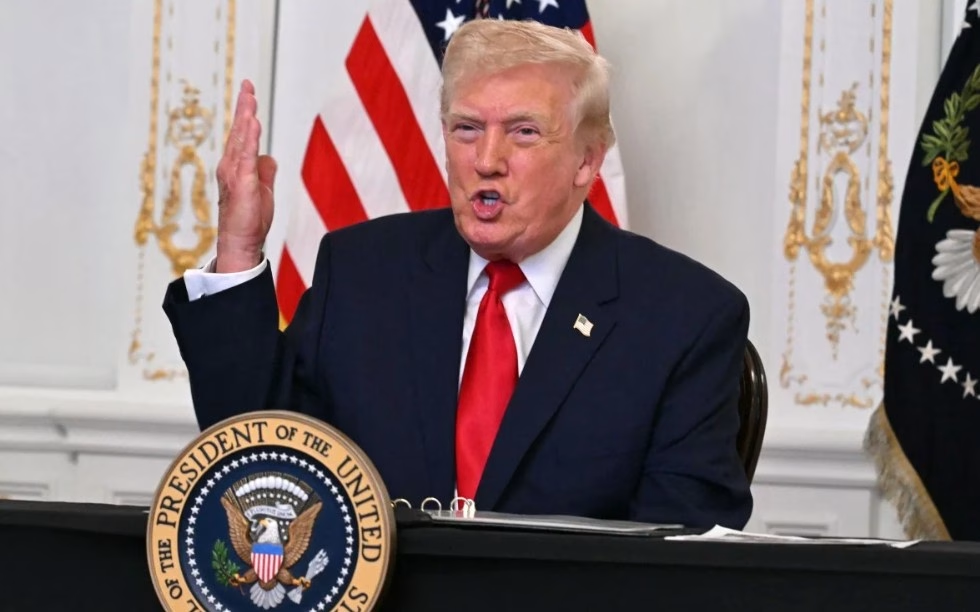
President Donald Trump on Monday called for Gulf allies to join the Abraham Accords amid talks between the U.S. and Iran to bring an end to hostilities in the Middle East.
The pressure comes as the two nations are reportedly working on a deal to extend the ceasefire in the region and reopen the Strait of Hormuz — while also laying the groundwork for broader talks over Tehran’s embattled nuclear program and potential sanctions relief. Officials on both sides have cautioned that key elements remain under negotiation.
“Negotiations with the Islamic Republic of Iran are proceeding nicely! It will only be a Great Deal for all or, no Deal at all — Back to the Battlefront and shooting, but bigger and stronger than ever before — And nobody wants that!” Trump wrote in a post on Truth Social.
The president said he spoke with multiple regional leaders over the weekend, including Saudi Arabia, Qatar, Pakistan, Egypt, Jordan, Bahrain, Turkey and the United Arab Emirates.
“I stated that, after all the work done by the United States to try and pull this very complex puzzle together, it should be mandatory that all of these Countries, at a minimum, simultaneously, sign onto the Abraham Accords,” he continued, acknowledging that the UAE and Bahrain were already members.
“It may be possible that one or two have a reason for not doing so, and that will be accepted, but most should be ready, willing, and able to make this Settlement with Iran a far more Historic Event than it would, otherwise, be,” Trump added.
The Abraham Accords were established in 2020 under the first Trump administration to broker ties between Israel and the Gulf states.
In his Memorial Day post, the president pressed Saudi Arabia and Qatar to join first, “and everybody else should follow suit.
“If they don’t, they should not be part of this Deal in that it shows bad intension,” he added,
As negotiations between U.S. and Iranian officials continue, Trump said Sunday that his administration would not “rush” into any deal, adding “time is on our side.” The emerging framework, however, is drawing intense criticism from Republicans, who compared parts of it to the Obama-era nuclear agreement.
On Saturday, the president pushed back on the scrutiny, focusing much of his ire on Republicans he has already labeled disloyal, including Sens. Thom Tillis (N.C.) and Bill Cassidy (La), as well as Rep. Thomas Massie (R-Ky.).
“I laugh at all of the Dumocrats, RINOS [Republicans in name only], and Fools who know nothing about the potential deal I am making with Iran, things that haven’t even been negotiated yet, weak and ineffective people like failed Senator Thom Tillis (Soon out of office!), Bill Cassidy, who just suffered a massive Primary loss, really bad Congressman Thomas Massie, a major sleazebag who lost in a landslide to a great American Patriot (Endorsed by “TRUMP”) after showing tremendous disloyalty to his Party (and Country!), and almost all Dumocrats, people that have totally lost their way, constantly supporting bad policy and even worse candidates, but are constantly critical of each and every fantastic win I have,” he wrote online.
GOP Sens. Roger Wicker (Miss.) and Lindsey Graham (S.C.) were also skeptical of the reported deal, arguing that extending the ceasefire would be a disaster for the U.S.
Secretary of State Marco Rubio, speaking to reporters in India on Sunday, blasted critics’ suggestion that the potential agreement would give Iran the upper hand as “absurd.”
“The idea that somehow this president — given everything he’s already proven he’s willing to do — is going to somehow agree to a deal that ultimately winds up putting Iran in a stronger position when it comes to nuclear ambitions is absurd,” he told reporters on Sunday.
THE HILL