
FG, CBN unveils new economic framework to tame inflation, growth acceleration.

The federal government and the Central Bank of Nigeria (CBN) have jointly launched a new economic framework known as the Dis-Inflation and Growth Acceleration Strategy (DGAS), aimed at sustaining growth above 7 percent, cutting inflation to single digits, and doubling national and household income to reduce poverty.
Traditional monetary tightening alone cannot deliver sustainable recovery, nor can fiscal expansion in isolation produce the scale of impact that our people require,” Uzoka-Anite said. “What Nigeria needs at this stage is a unified national framework that integrates both monetary and fiscal levers to drive non-inflationary growth and structural transformation.”
According to her, the DGAS aims to achieve sustained GDP growth above 7 percent while steadily bringing inflation to single digits through supply-side expansion rather than demand suppression.
She said the ultimate goal is to improve the quality of life for Nigerians. “National and household income will double, reducing poverty by a substantial percentage. And if we achieve more than 7 percent growth, then the period within which the income objective we are expecting will be accelerated,” she stated.
The minister explained that DGAS will be implemented through a “single-window execution platform” that unifies development finance, private capital mobilization, project incubation, policy coordination, and performance management under one institution.
“That platform will work hand-in-hand with the Central Bank and the Ministry of Finance,” she said. “It ensures that monetary policy incentives such as targeted credit windows and FX market reforms reinforce fiscal measures aimed at industrial expansion, job creation, and export growth.”
Uzoka-Anite described DGAS as a framework that “bridges fiscal intent with monetary execution,” bringing coherence between policy, capital, and productivity.
It enables us to move beyond fragmented interventions to a coordinated national strategy for incentivization and accelerating growth,” she said.
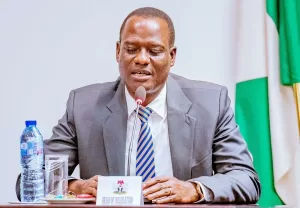
Speaking at the 2025 Annual Executive Policy Seminar held in Abuja on Tuesday, Minister of State for Finance, Dr. Doris Uzoka-Anite, said the DGAS represents the “second wave of reforms” under President Bola Tinubu’s administration, following bold actions on energy pricing and foreign exchange liberalization.
She explained that the DGAS, co-created by the Ministry of Finance and the CBN, seeks to integrate fiscal and monetary policies to deliver non-inflationary, inclusive growth.
The DGAS will be implemented through a “single-window execution platform”, bringing together development finance, private capital mobilisation, project incubation, and performance management under one institutional structure. The platform will coordinate closely with both the Ministry of Finance and the CBN to align incentives and policy outcomes.
According to Uzoka-Anite, the framework is designed to “bridge fiscal intent with monetary execution,” fostering coherence between capital, policy, and productivity. “It enables us to move beyond fragmented interventions to a coordinated national strategy for incentivisation and accelerating growth,” she said.
Key pillars of the strategy include capital mobilisation and financial innovation, with the Government aiming to attract long-term funding through mechanisms such as diaspora funds, global institutional financing, and guarantee-backed investments. These efforts are expected to reduce dependence on volatile portfolio inflows and short-term credit.
Uzoka-Anite emphasised the need for industrial replication of success stories like the Dangote Refinery, which she said could spur job creation, tax earnings, and wealth transfers across the economy. “If we replicate the Dangote refinery story in multiple sectors, it will result in sharp rises in job creation, tax earnings, and wealth transfers to households, investors, and entrepreneurs,” she said.
Energy diversification is also a major focus of DGAS, which targets the expansion of oil, gas, hydro, solar, wind, biomass, and hydrogen resources to power industrial growth. The framework will align with global carbon market mechanisms to attract green investment and support sustainable industrialisation.
Government also plans to enroll 10 million young Nigerians annually in technical and vocational programs linked to priority sectors, a move aimed at turning what Uzoka-Anite called “demographic pressure into productive capacity.”
DGAS will also introduce a revitalised consumer credit system to deepen domestic demand and financial inclusion. “It will allow citizens access to structured financing for housing, education, healthcare, automobiles, and household goods,” the minister said. “This transforms 200 million Nigerians into active participants in national prosperity.”
To support a more competitive business environment, the government intends to review regulations across agencies, with plans to eliminate as much as 40% of existing rules deemed to stifle enterprise.
Olayemi Cardoso, CBN Governor, speaking at the same event, pledged that the apex bank would work closely with fiscal authorities to ensure the success of the new strategy. He underscored that price stability remains central to the bank’s mandate and that a credible inflation-targeting framework will enhance predictability and investor confidence.
Investors run away from lack of predictability,” Cardoso said. “The more the predictability, the more the incentive for investors to come into your market. Once you get the fundamentals right and you’re doing the right things, investors naturally get attracted.”
Cardoso added that the CBN is improving its internal structure to strengthen policy credibility and human capital, and warned against returning to unsustainable fiscal practices that previously distorted the economy. “A situation where we had frightening ways and means to GDP ratios should never happen again,” he said.
Cardoso highlighted that the CBN’s ongoing reforms—working in tandem with DGAS—will reinforce macroeconomic stability, attract investment, and foster inclusive growth. “This economy belongs to all of us,” he said.
“We’ve all got to put everything together to ensure that, at the end of the day, we bake a bigger pie. Our GDP today relative to our population is not where we want it to be,” he stressed.