
Pope Leo XIV calls for AI to be ‘disarmed,’ directed to the common good
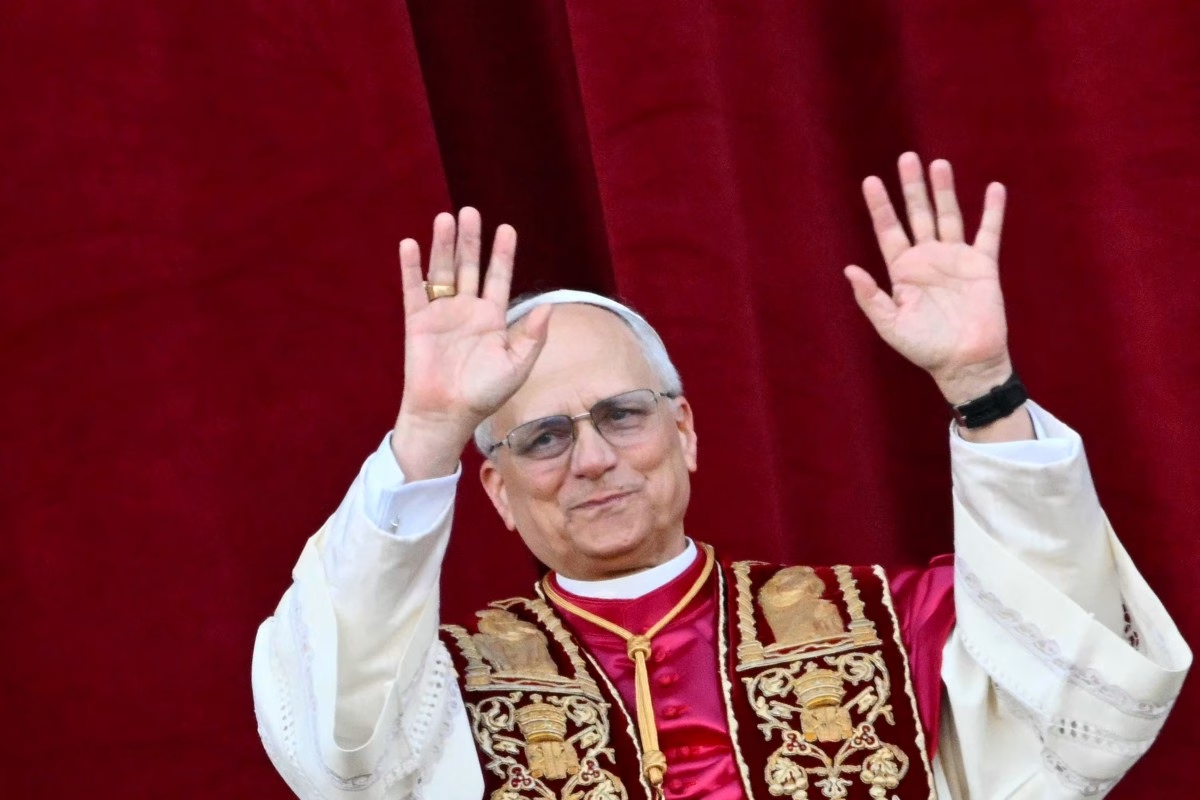
Newly elected Pope Leo XIV, Robert Prevost addresses the crowd on the main central loggia balcony of the St Peter's Basilica for the first time, after the cardinals ended the conclave, in The Vatican, on May 8, 2025. Robert Francis Prevost was on Thursday elected the first pope from the United States, the Vatican announced. A moderate who was close to Pope Francis and spent years as a missionary in Peru, he becomes the Catholic Church's 267th pontiff, taking the papal name Leo XIV. (Photo by Alberto PIZZOLI / AFP)
Full text of the address from Pope Leo XIV during the presentation and promulgation of his encyclical ‘Magnifica Humanitas.‘
Dear brothers and sisters,
I want to thank all of you for being here today, for your interest. I sincerely thank those who have organized this meeting today, and especially those who shared their competence and experience in the different reflections that we have listened to.
In a special way I would like to thank Mr Olah for accepting our invitation. In turn, in the name of the Church, I accept your invitation to walk together, to listen and to speak and together to find the way for humanity, in this time of artificial intelligence
What a great sign of hope that, with our differences, we can listen to one another. This interchange clearly bespeaks the gravity of the moment, as well as confidence that, together, we can discern the major questions of our time, and so, the future of humanity.
At key moments in history, the Church is called to decipher the “new things” in the light of the Gospel and the dignity of the human being. 135 years ago, my venerable predecessor Leo XIII observed the situation of factory workers, their families uprooted and new forms of poverty generated by rapid industrial transformation. He understood that the Church could not remain distant. Within an epochal turning point menacing human dignity, the encyclical Rerum Novarum spoke its evangelical and social word about “new things” underway.
Today we find ourselves facing a transformation of similar magnitude, with perhaps even greater consequences. Artificial intelligence already touches many areas of our lives and affects decisions that shape human coexistence. It is also dramatically changing how war is waged.
Like the earlier “Leo”, I feel entrusted to look upon another huge transformation with eyes of faith, with lucidity of reason, with openness to mystery, and with cries of the poor and the earth resounding in my heart.
Magnifica Humanitas was born from listening like Leo XIII did. I have listened to scientists and engineers who work with sincere enthusiasm on technologies capable of alleviating immense suffering; to political leaders and public officials who have perseveringly sought just rules; to parents and teachers who are deeply concerned for the future of younger generations.
Other, very troubling voices have also reached me about increasingly autonomous weapons systems practically beyond any human reach to govern them effectively. I hear very troubling accounts of algorithms that can block access to healthcare, employment and security on the basis of data tainted by prejudice and injustice. And I have heard the silence of those who have no voice when decisions are made—decisions likely to generate new forms of exclusion and suffering.
From this listening matured a disturbing conviction expressed in Magnifica Humanitas: artificial intelligence needs to be disarmed. The word is strong, I know, but deliberately chosen because this moment needs words capable of attracting attention, awakening consciences and indicating paths forward for humanity.
The Church has long been working for nuclear disarmament, aware that every great technical power can affect people’s lives and so must be accompanied by adequate moral discernment and public control. Nuclear disarmament remains a service to peace and the dignity of the human family.
In a similar sense, artificial intelligence now demands to be “disarmed,” freed from logics that turn it into an instrument of domination, exclusion and death. Like nuclear energy, it must be at the service of all and of the common good. Decisions about technology must never be separated from conscience and responsibility. “Let us not sleep as others do,” admonished the Apostle Paul, “but let us keep awake” (1 Thess 5:6). Such vigilance is necessary today. Peace, not merely the absence of war, is justice at work. But when technology weakens our critical sense, peace itself is at risk.
Disarming, however, is not enough. We must build.
The word “build” reminds me of my years as a missionary in Peru. In 2017, torrential rains and floods struck the north of the country: many families saw their homes swallowed by mud, and many roads, too. There I learned that rebuilding does not mean simply replacing what has been destroyed. It means repairing bonds, restoring trust, and reawakening hope in the future. Moreover, no one rebuilds alone.
In Magnifica Humanitas, I recall the biblical prophet Nehemiah. Before the ruined walls of Jerusalem, he gathers discouraged people to bring about rebirth. The image of walls does not legitimize closures or divisions, but invites each and everyone to do their part. Brick by brick, a more just coexistence takes shape, capable of safeguarding the dignity of all. Nehemiah’s effort speaks to our time. Artificial intelligence can be a construction site of history from within a horizon of communion, in which technical progress learns to serve human life.
“Let each builder choose with care how to build” (1 Cor 3:10) warns St. Paul. He does not fear the worksite; rather, he warns against building without solid foundations. Let’s not fear artificial intelligence, but constantly keep the question of the human in play. We cannot be careless with our most powerful technical instruments.
True development, says St Paul VI, always concerns “each man and the whole man.” “Each” means that no person can be left at the margins of digital transformation. “Whole” means that no one can be reduced to productivity, to cognitive performance, or to mere data. The person bears within him- or her-self a freedom, an interiority and a vocation to love and worship that no machine can replace or block.
Only with such an integral vision can artificial intelligence be directed toward the common good. Only together — those who design systems and those affected by them, richer countries and poorer ones, institutions and individuals, power centres and peripheries — will we be able to build a future, not for a privileged few, but for the entire human family.
This is the civilization of love which St Paul VI spoke and which St John Paul II so forcefully proclaimed as a horizon to seek together. It is not a naïve dream. It is a direction. It is the path that Jesus Christ opens within history.
For this reason, the Church wishes, with humility and frankness, to be part of conversations on artificial intelligence. We do not possess technical answers, nor do we seek to displace those with expertise. But we bring a wisdom concerning the human that our present time desperately needs: every person is unique and irreplaceable, a free and intelligent subject with a conscience, capable of seeking God, serving one another, caring for our common home.
I therefore invite all members of the Church and of the human family: let us learn to listen to one another, face the present challenges with courage, and cooperate in building a more human and fraternal society.
From this launch of Magnifica Humanitas, please take with you a commitment to stay awake and, as “artisans of hope”, to keep on building the worksite of our time. May the Spirit of the Risen Lord Jesus sustain our work together.
I entrust each of you to our Mother Mary. Her Magnificat sings of the greatness of God who uplifts the lowly. May she teach us to recognize the true greatness of every man and every woman in loving and serving. May the Lord make fruitful the great enterprise that today we entrust to his grace, letting the civilization of love mature in history.
Upon all of you I heartily invoke God’s blessing.
Blessing.
Thank you very much.
Vatican News