

Senate Declares Kidnapping as Terrorism, Recommends Death Penalty for Offenders
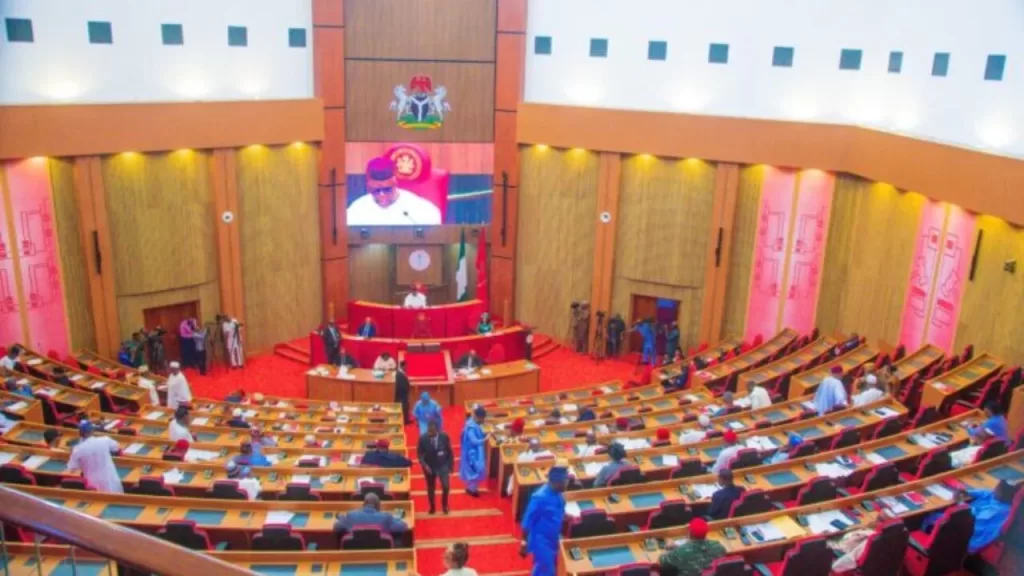
The Senate on Wednesday recommended the death penalty for kidnappers, declaring the crime a form of terrorism in response to the country’s worsening security crisis.
The resolution followed intense deliberations triggered by the November 18 attack on Christ Apostolic Church, Eruku, in the Ekiti Local Government Area of Kwara State, where gunmen killed two worshippers and abducted 38 others. All victims were later rescued through joint operations involving the military, police, DSS and local vigilantes.
Lawmakers, however, said the incident underscored the alarming southward expansion of insurgent activities and the deteriorating security situation in rural communities nationwide.
The resolutions arose from a motion sponsored by Senator Yisa Ashiru (Kwara South), titled “Urgent Need to Address Escalating Insecurity in Kwara, Kebbi, and Niger States and Strengthen National Security Frameworks.” The motion sparked widespread concerns over relentless attacks on schools, worship centres, highways and entire settlements.
Senators noted that repeated attacks on schools had forced the closure of all educational institutions across several local governments in Kebbi and Niger states, five LGAs in Kwara, and all 47 Federal Unity Colleges across the country.
Contributing to the debate, Senator Issa Jibrin (Kogi East) lamented the country’s overwhelming security manpower deficit, warning that Nigeria’s entire armed forces, police and paramilitary personnel “do not total one million,” compared to Egypt’s 1.5 million.
He called for immediate upgrades in equipment, improved intelligence coordination and the establishment of a reserve security force to support overstretched frontline personnel.
The Senate said the death penalty recommendation reflects the gravity of the threat kidnapping poses to national stability and stressed the need for urgent reforms to restore public confidence and secure vulnerable communities.
Senators noted that the frequency of school abductions had forced the shutdown of all schools in local governments across Kebbi and Niger states, five LGAs in Kwara, and all 47 Federal Unity Colleges nationwide.
Senator Issa Jibrin (Kogi East) decried the country’s critical manpower deficit in security services, warning that Nigeria’s entire military, police, and paramilitary personnel “do not total one million,” compared to Egypt’s 1.5 million.
He pushed for urgent equipment upgrades, better intelligence coordination, and a reserve force to support overstretched troops.
Other senators raised concerns that banditry was creeping closer to Osun through Ekiti-linked communities around Eruku–Isapa–Koro — areas where a retired Army General and a traditional ruler were recently killed.
Lawmakers also blamed attacks on bad roads that enable criminals to escape easily, directing the Federal Ministry of Works to immediately begin reconstruction of the Idofian–Omu-Aran–Eruku–Egbe–Kabba corridor.
Amid rising brutality and ransom-driven networks, senators resolved that kidnapping had evolved into full-fledged terrorism and must attract the severest punishment. “Capital punishment must apply,” several lawmakers argued, insisting that no judge should have the power to reduce the sentence for convicted kidnappers.
The Senate further urged President Bola Tinubu to “further rejig the nation’s security architecture,” a call that prompted Senator Ali Ndume to warn that such language could be misread, given the recent confirmation of service chiefs.
The chamber, however, clarified that its demand focused on improving coordination, technology, intelligence, and rapid deployment.


