Tinubu seeks fresh ₦1.15tn domestic loan to fund 2025 budget deficit
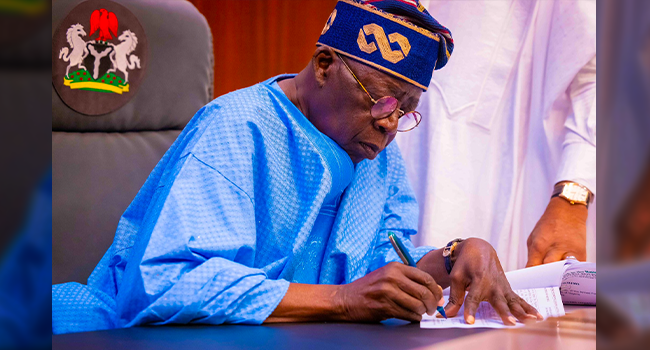
President Bola Tinubu has requested the National Assembly’s approval for a new ₦1.15tn domestic loan to fund part of the deficit in the 2025 national budget.
The request, contained in a letter from the President, was read by Senate President Godswill Akpabio during Tuesday’s plenary.
Tinubu explained that the borrowing is necessary to bridge the fiscal shortfall and ensure the smooth execution of priority programmes and projects outlined in the 2025 budget.
“This request is in line with Section 44 (1) and (2) of the Fiscal Responsibility Act 2007 and Section 1(7) of the Executive Order, which mandate National Assembly approval for all new borrowings and appropriation of proceeds,” the President stated.
Following the reading of the letter, Akpabio referred the request to the Senate Committee on Local and Foreign Debt for further consideration, directing the committee to report back within one week.
The fresh loan request comes barely five days after the Senate approved another of Tinubu’s proposals — a $2.847bn external borrowing plan, which includes a $500m debut Sovereign Sukuk, aimed at financing the 2025 budget deficit and refinancing maturing Eurobonds.
According to the Senate Committee on Local and Foreign Debts, chaired by Senator Wamakko Magatarkada Aliyu (APC, Sokoto North), $2.347bn will be sourced from the international capital market, while $500m will be raised through Sukuk bonds to fund key infrastructure projects nationwide.
This is the latest in a series of borrowing requests by the Tinubu administration. In May 2025, the President sought Senate approval for a $21.5bn external loan to finance critical projects in infrastructure, health, education, and water supply. He also requested authorisation for a ₦758bn domestic bond to clear outstanding pension liabilities under the Contributory Pension Scheme.
According to the Debt Management Office, Nigeria’s total public debt stock rose to ₦152.40tn as of June 30, 2025 — an increase of ₦3.01tn or 2.01 per cent from ₦149.39tn recorded at the end of March.
In dollar terms, the debt increased from $97.24bn to $99.66bn, reflecting a 2.49 per cent rise within three months.
The figures highlight the Federal Government’s growing reliance on domestic and external borrowings to finance fiscal gaps, even as ongoing revenue and foreign exchange reforms continue to reshape Nigeria’s economic landscape.