
2027: Senators Endorse Akpabio For 11th Senate Presidency

He said his position reflected his standing as a serving senator and a prospective member of the 11th Assembly.
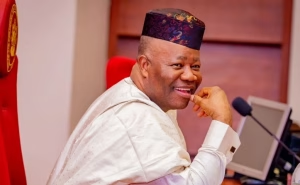
Akpabio subsequently called on senators present to indicate their support for the motion, as the declaration was extended to cover the office of the Deputy Senate President and other principal officers.
The development signals an early political positioning ahead of the constitution of the 11th National Assembly, with the struggle for presiding offices expected to intensify as political parties and lawmakers begin calculations over the next legislative leadership.
Akpabio acknowledged that the Senate presidency had become a major attraction for politicians following the conclusion of contests for other top political offices.
“I know the position of president is gone, position of vice president is gone, the only one that is left now is position of Senate President. So everybody will want to contest that,” he said.
He expressed confidence that many serving senators would return to the chamber, while the declaration underscored the determination of his supporters to consolidate his position before the next Assembly.
However, the senators’ declaration does not constitute a formal election of presiding officers for the 11th National Assembly. The leadership positions will ultimately be determined through the applicable legislative procedures when the new Assembly is inaugurated.
Akpabio Warns Against Political Manipulation
Beyond the leadership question, Akpabio launched a strong warning against what he described as politically motivated distortions of Senate debates, accusing television commentators and political analysts of taking lawmakers’ contributions out of context.
He insisted that disagreements on the Senate floor were part of the legislative process and should not be weaponised to discredit lawmakers or inflame political and religious tensions.
“I don’t like the idea of people sitting down on television and trying to misinterpret what we discuss here in the Senate. We want to make the best laws, so we are bound to oppose each other and we are also bound to support each other, no matter the discussion,” Akpabio said.
He urged commentators to focus on the Senate’s final decisions rather than isolate individual contributions and present them as the position of the entire chamber.
“Please take the final decision of the Senate into consideration. Don’t go and sit down in panels and try to do politically motivated discussions,” he added.
His remarks followed public controversy surrounding a debate on a proposed review of the criminalisation of suicide, which triggered discussions about mental health, religion, terrorism and the interpretation of Islamic teachings.
Akpabio rejected suggestions that his contribution was an attack on Islam, insisting that terrorism should not be associated with any particular religion.
‘Terrorism Has No Religious Affiliation’
The Senate President argued that terrorists should be judged by their actions rather than the religious identities they claim, maintaining that neither Islam nor Christianity should be blamed for acts of violence.
“Terrorists are not Muslims. Terrorists are not Christians. Terrorists are human beings who believe in taking their lives and the lives of others,” he said.
He maintained that Islam prohibits suicide and the killing of innocent people, arguing that suicide bombings cannot be justified through claims of religious reward in the afterlife.
“The Muslim religion that I know forbids suicide. It forbids killing. The Muslim religion that I know does not even allow somebody to take his own life,” he said.
Akpabio said the Senate’s consideration of suicide-related legislation was intended to examine the circumstances surrounding such acts, including cases involving mental illness, and determine whether existing laws require reform.
He stressed the need to distinguish between individuals experiencing mental health crises and those who deliberately engage in violent acts against themselves and others.