

State Police: Senate says 84 senators backed bill in national interest
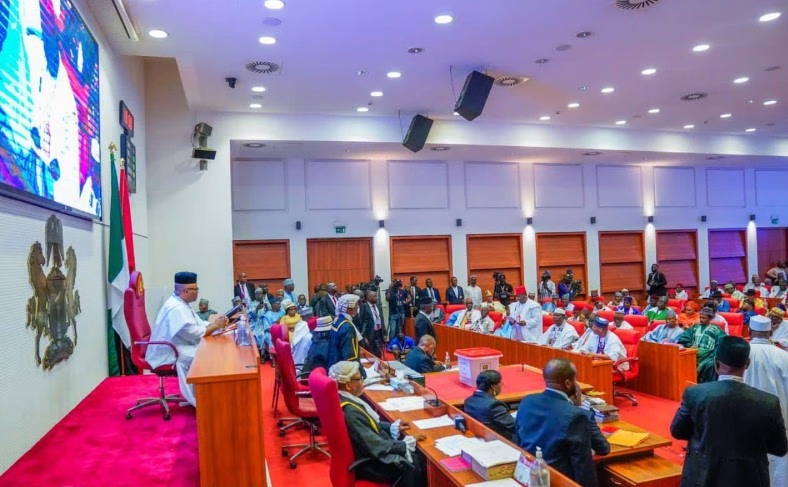
The Senate on Sunday defended the passage of the Constitution of the Federal Republic of Nigeria (Alteration) (State Police) Bill, 2026, insisting that the proposed creation of state police, which 84 senators voted for, is a response to Nigeria’s worsening security challenges.
The upper chamber said the bill emerged from years of consultations, public engagements, and broad national consensus, stressing that it would be wrong to delay the proposal for political calculations ahead of the 2027 general election.
The position comes amid growing debate over the constitutional amendment bill, with supporters arguing that decentralising policing will improve security at the grassroots, while critics fear that state police could be abused by governors to intimidate political opponents.
Defending the Senate’s decision in a statement issued by his media office on Sunday, the Leader of the Senate, Senator Opeyemi Bamidele, said the proposal was “purely a child of necessity and not of political expediency as well as a product of national consensus and not of cynicism.”
He maintained that the establishment of state police had become a matter of urgent national importance that should not be sacrificed because of anyone’s political ambition.
According to him, the process leading to the passage of the bill did not begin recently but evolved through extensive constitutional review engagements involving key stakeholders across the country.
Despite some dissenting views, Bamidele said observations had shown that Nigerians largely welcomed the passage of the bill with the belief that it would significantly improve security at the sub-national level.
He said, “The State Police proposal was part of memoranda submitted to the Senate Ad-hoc Committee on the Review of the 1999 Constitution. The memorandum had been subjected to a rigorous process and multi-tiered consultation across the federation due to its sensitive nature.
“During this process, the National Assembly broadly consulted the Executive, Nigerian Governors Forum, Conference of Speakers of the State Legislatures of Nigeria and the leadership of the Nigeria Police, among others.
“In July 2025, the National Assembly conducted public hearings in all geopolitical zones, and the participants overwhelmingly approved it. At each level of our consultation, nearly all stakeholders embraced the State Police Bill in the light of stark realities we are facing today.”
The Senate Leader said the Nigerian Police actively contributed to the drafting of the constitutional amendment by offering recommendations that helped lawmakers build safeguards against potential abuse of state police by political actors.
According to him, those recommendations formed part of accountability and oversight mechanisms embedded in the legislation to ensure that state police operate within constitutional limits.
He added that the willingness of the Nigerian Police to support the proposal underscored its strategic importance in addressing insecurity at the local and state levels.
Beyond the contributions of the police hierarchy, Bamidele said the bill was subjected to extensive debates in both chambers of the National Assembly before its eventual passage.
He noted that support for the legislation cut across party lines.
He said: “Even though the APC is the majority, there are members of opposition parties – PDP, ADC, NDC and Labour Party – that exercised their discretion in favour of the Bill, mainly in the national interest and not on a parochial basis.
“In the Senate, for instance, 84 out of 109 members voted clause by clause in support of the Bill. This accounted for 77.06% approval at the Senate alone.”
Bamidele argued that security should transcend political affiliations, noting that countries facing security threats often unite behind reforms aimed at strengthening national safety.
Globally, he said, security “is a collective public good that benefits citizenry across ethnic, political and religious divides. Political actors elsewhere always throw off their togas of partisanship and parochialism to support initiatives that will boost and reinforce national security.”
He therefore urged opposition parties to contribute constructive ideas that would strengthen peace and stability across the federation rather than oppose initiatives solely on political grounds.
At this challenging time, Bamidele observed that opposition parties and leaders should come forward with ideas that would deepen the peace and stability of the federation.
Even when they disagree on some grounds, according to him, they are under obligations to provide credible and useful ideas that can make our Nation better and greater. Unfortunately, they have not passed this critical test of opposition democracy.
The National Assembly is expected to transmit the Constitution Alteration Bill to the 36 state Houses of Assembly for consideration. Under Section 9 of the 1999 Constitution, constitutional amendment bills require the approval of at least 24 state legislatures before they can be presented to the President for assent.